Kurahi Industrial
Understand legacy systems before you change them.
Modernisation starts with knowing what the code does. Deterministic analysers produce the facts, every fact cites the file and line it came from, and the agent explains those facts instead of guessing.
What adopting it involves
Comes ready
- Analysers for COBOL and JCL, PL/I, FORTRAN, Java, SQL DDL and PLC code
- Change detection against a saved baseline
- 設計書 in Japanese or English as Word, every fact cited to path:line
- A nightly routine that prepares changes for review
- An MCP server for IDEs
Needs configuration
- The source folders, read-only, as a Project
- The baseline to compare against
- Who reviews the documents and changes
- The schedule of the nightly routine
Who sets it up
- Your IT administrator installs Kurahi and registers the source folders
- A lead engineer chooses the baseline and the reviewers
- KODA SōKEN can do the setup with you under an Enterprise agreement
What engineers learn
- Reading a 設計書 against its path:line citations
- Resolving the items marked 要確認 (needs confirmation)
- Reviewing detected changes as work items
Scoped separately
- Languages and dialects outside the supported list
- In-house frameworks and generated code that need extra rules
- Document templates specific to your company
From source code to a design document you can review
What is analysed
- COBOL and JCL
- Programs, copybooks and job steps
- PL/I
- Programs and embedded SQL calls
- FORTRAN
- Programs and their call structure
- Java
- Including JPA mappings compared with the DDL
- MyBatis
- Mapper XML linked to the Java that calls it
- SQL databases
- DDL and stored procedures (DB2 SQL PL, PL/SQL, package bodies) linked to their callers in Java, COBOL and PL/I
- PLC
- IEC 61131-3 Structured Text, and FBD and LD networks in PLCopen XML exports. Source text only; never connects to a controller
Industrial capabilities in detail
Every capability of Kurahi Industrial: what is analysed, the agent tools, the 設計書, change detection and Autopilot.
Languages and formats analysed
| Capability | What it does |
|---|---|
| COBOL programs | Reads paragraphs, PERFORM/CALL graphs, file access, and EXEC SQL / EXEC CICS access, with path:line for every fact. |
| COBOL copybooks | Builds a field-level data dictionary from copybooks, including COPY resolution. |
| JCL jobs and procedures | Reads jobs, steps, EXEC PGM/PROC, DD statements and data sets, which are used for job flow and data set lineage. |
| Java (incl. Spring, JPA, MyBatis) | Reads classes, interfaces, enums, records, methods and fields; resolves inheritance and static calls; and finds table access from JPA, Spring Data, @Query, JDBC SQL literals and MyBatis mapper XML. |
| JPA mapping vs DDL comparison | Compares JPA join mappings with the foreign keys in the DDL and reports joins that have no foreign key, and foreign keys that no mapping uses. |
| SQL DDL | Reads CREATE TABLE/VIEW/INDEX, columns, keys, comments, ALTER and COMMENT ON (ANSI, DB2, Oracle, PostgreSQL basics). A table defined in more than one schema gets one node per schema. |
| SQL stored routines (DB2 SQL PL, Oracle PL/SQL) | Links procedures, functions, triggers and Oracle package members to the tables and routines they use. Dynamic SQL is listed as a gap. |
| FORTRAN (fixed form 77, free form 90+) | Reads program units, CALL/USE/INCLUDE, COMMON blocks with layout checks, EQUIVALENCE, and file I/O units bound through JCL. |
| PL/I | Reads procedures, CALL edges, %INCLUDE, DECLARE structures, files bound to JCL DD statements, EXEC SQL tables and ON-units. |
| PLC Structured Text (IEC 61131-3: .st .scl .iecst) | Reads PROGRAM, FUNCTION_BLOCK and FUNCTION units, VAR sections, an I/O map of %I/%Q/%M addresses, duplicate addresses, FB instances and writes. Works on source text only and never connects to a controller. |
| PLCopen XML (TC6 0201) | Reads the same facts at the XML line, including ST bodies and FBD/LD block calls and coil writes. IL/SFC bodies are reported as gaps. |
| Language detection and routing | Recognises files by extension or by content, and sends each content-detected file to exactly one engine. |
| Cross-language shared tables | Treats a table seen in COBOL EXEC SQL, PL/I, JPA @Table and CREATE TABLE as one node, so CRUD and impact work across languages. |
Agent tools (legacy_*, modernise_*)
| Capability | What it does |
|---|---|
| legacy_index | Parses COBOL, copybooks and JCL in a folder and builds a cached fact index with counts and diagnostics. |
| legacy_index_build (MCP only) | The editor server's version of the index build. |
| legacy_index_status (MCP only) | Reports whether a fresh index exists for a scope, with counts. It never parses. |
| legacy_query | Answers structural questions with file:line: summary, programs, paragraphs, callers, callees, call-graph, perform-graph, file-access, data-item, data-refs, job-steps, datasets, unresolved, graph-neighbours, call-chains, lineage. |
| legacy_rules | Lists business-rule candidates such as conditions, arithmetic with constants, ROUNDED, 88-level values and literals. It quotes the exact source text and does not infer meaning. |
| legacy_dictionary | Builds a copybook data dictionary: level, PIC, USAGE, bytes, offset, positions, OCCURS, REDEFINES, VALUE/88 and comment text. |
| legacy_impact | Shows what a change to a COBOL data item reaches (shared storage, data flow, copybook users, CALL USING, data sets, job steps), each with its linking fact. |
| legacy_design_doc | Generates a design document from the code. See section 3. |
| legacy_wave_plan | Proposes migration waves for human review. See section 4. |
| legacy_changes (agent tool only, not on MCP) | Compares the sources with a stored baseline. See section 4. |
| legacy_baseline_advance (agent tool only, not on MCP) | Moves the change-detection baseline forward to the snapshot that was last compared, or resets it from the current sources. |
| modernise_plan | Detects the languages in a folder, runs the active engines, and returns the combined inventory, shared tables with CRUD, coverage gaps, and the files that planned assistants would cover. |
| modernise_crud | Shows table CRUD across COBOL, PL/I, Java and JCL utilities, and file CRUD across COBOL, FORTRAN and PL/I, with path:line per operation. |
| modernise_impact | Shows the cross-language impact of changing a table, column, data set, FORTRAN COMMON block or module, Java class, or program. |
| modernise_inventory | Lists or details Java types, SQL tables and views, FORTRAN units and COMMON blocks, PL/I procedures, or PLC POUs and the I/O map (kind `plc`). |
Design document (設計書)
| Capability | What it does |
|---|---|
| Design document in Japanese or English | Writes a Markdown document from code in which every fact line cites path:line. Business purpose and rule meaning are left as marked placeholders for confirmation (要確認). |
| Sections | Includes the sections overview, jobs, programs, java, fortran, pli, plc, dictionary, tables, crud and coverage. A section is added only when the folder has that language. |
| Mermaid diagrams | Includes system overview and per-job flow diagrams generated from the graph. |
| PLC program specification | Includes the POU list, an I/O allocation table by %I/%Q/%M address, and the variables of each POU. |
| Java, FORTRAN, PL/I and table specifications | Adds Java class specs, FORTRAN units with a COMMON map, PL/I procedure specs, and table definitions when those sources are present. |
| Word (.docx) output | With `output_format: docx`, also writes `設計書_YYYYMMDD.docx` (English: `design-doc_YYYYMMDD.docx`) to the Project's `output/design-docs/` and never overwrites an existing file. |
Change detection, wave plan, impact
| Capability | What it does |
|---|---|
| Change detection against a baseline | Lists COBOL programs, copybooks, JCL jobs, and SQL tables, columns and routines that were added, removed or changed, plus CALL/PERFORM/EXEC SQL/step edges, with evidence and the impact of each changed program. The baseline is stored in `output/.legacy-index/baseline/`. |
| Migration wave plan | Proposes COBOL program waves from CALL and data-set dependencies, cycles (SCCs), coupling, size and complexity, and a documented risk score, in ja/en Markdown, for human review. |
| Knowledge graph and data lineage | Provides graph neighbours, call chains up or down, and data-set/table lineage through utility steps. |
| Coverage report | Lists constructs that were not modelled, unresolved calls, missing copybooks, skipped DDL and other gaps, so it is clear what was not analysed. |
Autopilot, workbench, packs and editor integration
| Capability | What it does |
|---|---|
| Industrial Autopilot routine nightly-legacy-analysis | Runs nightly at 01:30 JST and after a source drop. If the sources changed, it regenerates the Word 設計書, opens one work item with the changes, then advances the baseline. If nothing changed, it makes no model call. Level L1. |
| Industrial modernisation project template | A Project template in which source/, data/ and docs/ are read-only and output goes to output/ only. It includes rules, playbooks, a rule-table template, an assessment template, and queues (解析結果レビュー, 設計書レビュー, 移行計画, 品質・リスク). |
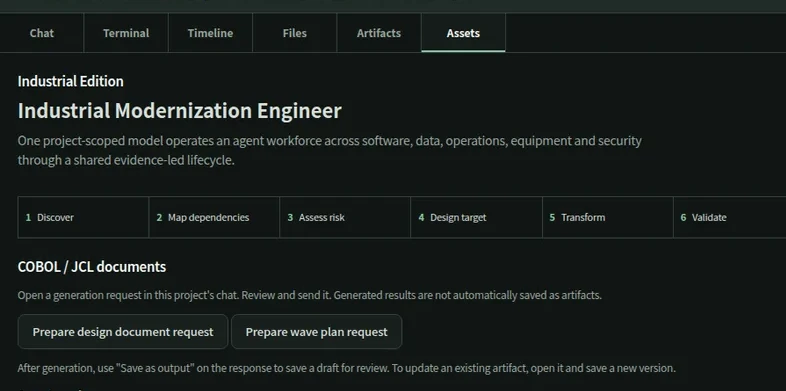
| Industrial workbench (Assets view) | Project screen with tabs (チャット, 端末, タイムライン, ファイル, 成果物, 資産), the modernisation lifecycle, and a domain grid that takes its status from the engine registry. |
| Design doc / wave plan request buttons | Opens a prepared chat request that runs `legacy_design_doc` or `legacy_wave_plan`, for review before sending. |
| Agent packs with readiness | Shows five Industrial packs with their readiness: Analysis (利用可能), Modernisation and Maintenance (設定確認が必要), Controls (オフライン環境の準備が必要), Cybersecurity (現在は利用できません); only Analysis is backed by an engine today. |
| Legacy MCP server for editors (kurahi legacy mcp) | A standalone MCP server over stdio or loopback HTTP for VS Code, Eclipse-based IDEs and other MCP clients. It is confined to one project root, caps response size, and keeps an append-only audit log. |
設計書, generated from the code
Design documents in Japanese or English, written as Word files. Every fact line cites path:line, and what the code cannot tell is marked as needing confirmation (要確認) instead of being guessed.
Change detection against a baseline
A stored baseline lets the nightly analysis report only what changed, with file and line evidence. The baseline moves forward only after the change has reached a person as a work item.
Wave plan
A proposed migration order from the dependencies and a printed risk formula, labelled as a proposal for people to review and decide.
In the engineer's editor
The kurahi-legacy MCP server brings the same read-only analysis to VS Code, Eclipse-based IDEs and any MCP client.
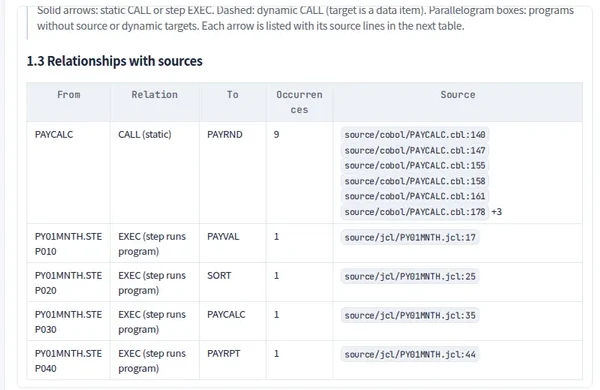
A fictional payroll system, read end to end
Four COBOL programs, two copybooks and a four-step JCL job for a fictional company. No records from a real organisation are used.
Autopilot for engineering, with hard limits
A nightly routine can analyse the code base, detect changes and prepare the 設計書. It never writes to production OT or a PLC and never merges into or deploys to a customer system. Opening a pull request needs L3 and a standing approval naming the repository.
Bắt đầu từ một quy trình.
Hãy cho chúng tôi biết công việc bạn muốn giao. Chúng tôi sẽ trình diễn Kurahi trên một quy trình giống của bạn và giúp bạn quyết định nên đi xa đến đâu.
Liên hệ
Trao đổi về công việc, các hệ thống liên quan và ai phê duyệt việc gì.
Liên hệYêu cầu báo giá
Nhân sự số, quản trị dữ liệu, triển khai cách ly và hỗ trợ theo SLA, theo thỏa thuận bằng văn bản.
Yêu cầu báo giáBắt đầu miễn phí
Cài Kurahi trên máy chủ của bạn và dùng miễn phí các phiên bản, hàng đợi công việc và Autopilot ở mức L0 và L1.
Bắt đầu miễn phí