Deployment and data boundaries
このコンテンツはまだ日本語訳がありません。
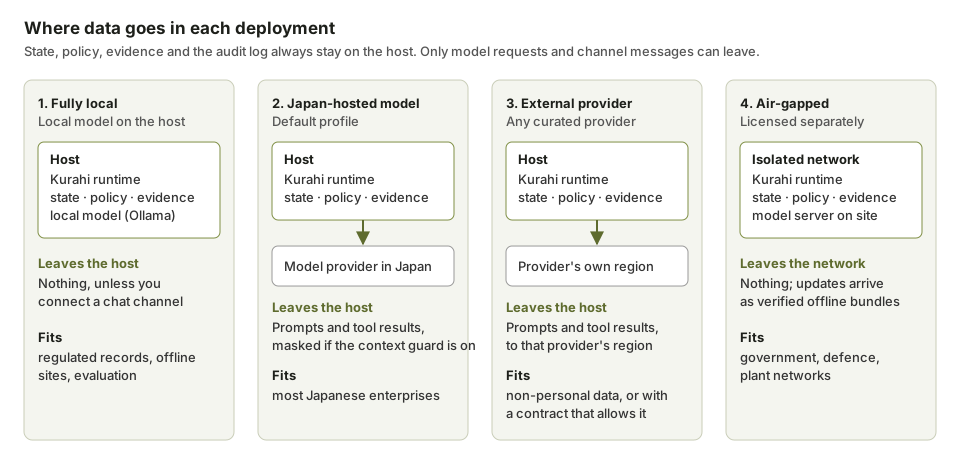
Whatever you choose, the runtime’s own records stay on the host that runs it: configuration, policy, memory, sessions, evidence bundles, the audit log and secrets. Two kinds of traffic can leave, and both are under your control:
- Model requests. The prompt, the conversation so far and tool results go to the model you configure. With a local model they never leave the host. With the context guard on, personal data in tool results is replaced with placeholders before it is sent.
- Channel messages. If you connect LINE, Slack, Teams or another channel, messages to and from people pass through that service.
| Configuration | Model runs | Leaves the host | Typical fit |
|---|---|---|---|
| 1. Fully local | On the host, through Ollama or another local server | Nothing, unless you connect a channel | Regulated records, sites without internet, evaluation |
| 2. Japan-hosted model (default profile) | Sakura AI Engine, in Japan | Model requests, to Japan | Japanese enterprises that need domestic processing |
| 3. External provider | Any curated provider | Model requests, to that provider’s region | Non-personal data, or where your contract allows it |
| 4. Air-gapped (licensed separately) | A model server on the isolated network | Nothing; installation and updates arrive as verified offline bundles | Government, defence, plant networks |
You can mix them per agent: one agent on a local model for HR records, another on a hosted model
for public research. The policy can restrict which providers and models each agent may
call (agents.<id>.providers, agents.<id>.models), so a mistake in configuration cannot send an
agent’s data somewhere the policy does not allow.
Check the region and retention terms of any hosted provider against your own obligations; the region notes in the registry quote each provider’s documentation, not a contract.
Each release publishes SHA256SUMS.txt and a build provenance attestation; verify the download
against them before installing on a managed host (builds are not code-signed or notarised).